Manual Machining vs CNC Machining vs CNC Automation: Complete Comparison Guide
Introduction
Manufacturing technology has changed significantly over time. Manual machining, CNC machining, and CNC automation represent different stages of manufacturing development. Each method has its own advantages, limitations, and suitable applications.
Manual machining depends on the skill and experience of an operator. CNC machining uses computer-controlled instructions to operate machines with high precision. CNC automation takes CNC technology further by adding automated systems such as robotics, sensors, and intelligent control systems.
Understanding the differences between manual machining, CNC machining, and CNC automation helps manufacturers choose the right production method based on accuracy requirements, production volume, budget, and operational goals.
What Is Manual Machining?
Manual machining is a traditional manufacturing method where an operator controls machine movements manually. The machinist uses physical controls such as hand wheels, levers, and switches to operate equipment.
Common manual machines include:
Manual milling machines
Manual lathes
Drill presses
Grinding machines
The operator controls cutting speed, tool movement, and machining operations based on experience and technical knowledge.
Manual machining has been used for decades and remains valuable for repair work, prototypes, maintenance operations, and small production tasks.
How Manual Machining Works
The manual machining process begins with a technical drawing or design specification.
The operator analyzes the required dimensions and manually adjusts the machine settings. Cutting tools remove material from a workpiece until the desired shape is achieved.
The machinist is responsible for:
Setting machine parameters
Positioning the workpiece
Controlling cutting tools
Measuring finished parts
Making adjustments during production
The final quality depends heavily on the operator’s skills and attention.
Advantages of Manual Machining
Lower Initial Investment
Manual machines generally cost less compared to CNC machines. Small workshops often choose manual equipment because it requires less investment.
Simple Operation
Manual machines do not require advanced programming knowledge. Experienced machinists can operate them using mechanical skills.
Suitable for Custom Work
Manual machining works well for one-off parts, repairs, and small production jobs where programming a CNC machine may take more time.
Easier Maintenance
Manual machines have fewer electronic components, making maintenance and repairs simpler.
Limitations of Manual Machining
Lower Accuracy
The accuracy of manual machining depends on the operator’s skill. Human errors can affect final dimensions and consistency.
Slower Production
Manual machining requires continuous operator involvement, which limits production speed.
Difficult Complex Designs
Producing complicated shapes manually can be challenging and time-consuming.
Limited Repeatability
Creating identical parts repeatedly is more difficult because every operation depends on manual control.
What Is CNC Machining?
CNC machining stands for Computer Numerical Control machining. It uses computer programs to control machine movements and manufacturing operations.
Instead of manually controlling the machine, operators create programs that define:
Tool movement
Cutting paths
Machine speed
Production sequence
The CNC controller reads these instructions and operates the machine automatically.
Common CNC machines include:
CNC milling machines
CNC turning machines
CNC routers
CNC grinding machines
CNC machining is widely used in industries requiring precision and repeatable production.
How CNC Machining Works
The CNC machining process starts with creating a digital design using CAD software.
The design is transferred into CAM software, which generates machining instructions. These instructions are converted into G-code and sent to the CNC controller.
The CNC controller manages machine operations by controlling:
The machine follows programmed instructions to manufacture the component.
Advantages of CNC Machining
High Precision
CNC machines provide accurate movements that allow manufacturers to produce components with tight tolerances.
Better Repeatability
A CNC program can produce the same part thousands of times with consistent results.
Faster Production
CNC machines reduce manual involvement and complete complex operations faster.
Complex Manufacturing Capability
CNC machines can create complex geometries that are difficult to achieve through manual machining.
Reduced Human Errors
Computer-controlled operations reduce mistakes caused by manual adjustments.
Limitations of CNC Machining
Higher Initial Cost
CNC machines require more investment compared to traditional manual machines.
Programming Requirements
Operators need knowledge of CNC programming, CAD/CAM software, and machine operation.
Maintenance Complexity
CNC machines contain advanced electronics, motors, and control systems that require specialized maintenance.
What Is CNC Automation?
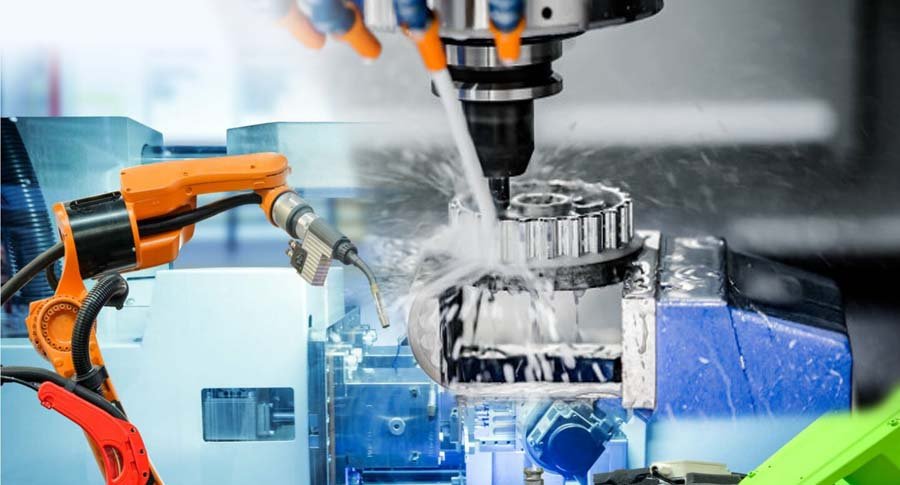
CNC automation is an advanced form of CNC machining where additional automated technologies are integrated into CNC systems.
CNC automation combines:
CNC machines
Robotics
Sensors
Automated material handling
Production monitoring systems
The goal of CNC automation is to reduce manual involvement and create a more efficient manufacturing process.
Automated CNC systems can perform tasks such as:
Loading raw materials
Changing tools automatically
Inspecting finished parts
Managing production cycles
How CNC Automation Works
CNC automation starts with the same programming process used in CNC machining.
A digital design is converted into machine instructions through CAD/CAM software.
The difference is the additional automation systems connected with the CNC machine.
Examples include:
Robotic Arms
Robots can load and unload parts without requiring an operator.
Automatic Tool Changers
Machines can switch between different tools automatically during production.
Sensors
Sensors monitor machine performance and provide real-time feedback.
Manufacturing Software
Advanced systems track production data and optimize operations.
Advantages of CNC Automation
Maximum Production Efficiency
CNC automation allows machines to operate continuously with limited human involvement.
Increased Productivity
Automated systems reduce downtime caused by manual loading, adjustments, and inspections.
Improved Quality Control
Sensors and monitoring systems help maintain consistent product quality.
Reduced Labor Requirements
Automation handles repetitive tasks and allows workers to focus on higher-value activities.
Smart Manufacturing Integration
CNC automation supports Industry 4.0 technologies such as IoT, artificial intelligence, and data analytics.
Limitations of CNC Automation
High Investment Cost
Complete automation systems require significant investment in machines, robots, software, and integration.
Technical Expertise Required
Businesses need skilled professionals for programming, operation, and maintenance.
Complex Implementation
Integrating automation into existing production systems requires careful planning.
Manual Machining vs CNC Machining vs CNC Automation Comparison
Feature
Manual Machining
CNC Machining
CNC Automation
Operation
Human controlled
Computer controlled
Fully automated systems
Accuracy
Depends on operator
High accuracy
Very high accuracy
Production Speed
Slow
Fast
Extremely fast
Programming
Not required
Required
Advanced programming required
Labor Requirement
High
Medium
Low
Production Volume
Small jobs
Medium to large production
Mass production
Complexity
Limited designs
Complex designs
Advanced manufacturing
Cost
Low
Medium
High
Which Manufacturing Method Should You Choose?
The right choice depends on production requirements.
Choose Manual Machining When:
Production volume is low
Parts require frequent adjustments
Budget is limited
Repair work is required
CNC Machining When:
High accuracy is required
Parts need repeatability
Production volume is medium or large
Complex designs are involved
Choose CNC Automation When:
Production volume is very high
Continuous operation is needed
Labor reduction is important
Smart manufacturing systems are required
Future of Manufacturing: Moving Toward CNC Automation
Manufacturing industries are increasingly moving from traditional machining toward automated CNC systems.
Modern factories are adopting:
Artificial intelligence
Robotics
IoT monitoring
Predictive maintenance
Smart production systems
CNC automation provides manufacturers with higher efficiency, better quality control, and improved production capabilities.
Conclusion
Manual machining remains useful for simple tasks and custom work. CNC machining provides accuracy and repeatability for modern manufacturing. CNC automation delivers the highest level of productivity through robotics, sensors, and intelligent systems.
Understanding these differences helps businesses select the right manufacturing approach for their production needs and prepare for the future of automated manufacturing.