Choosing the right CNC machine can improve accuracy, productivity, and production costs. This guide to 3-Axis vs 4-Axis vs 5-Axis CNC Machines explains the key differences and helps you choose the right CNC setup.
What Are CNC Machine Axes?
CNC machine axes describe the directions in which the machine can move.
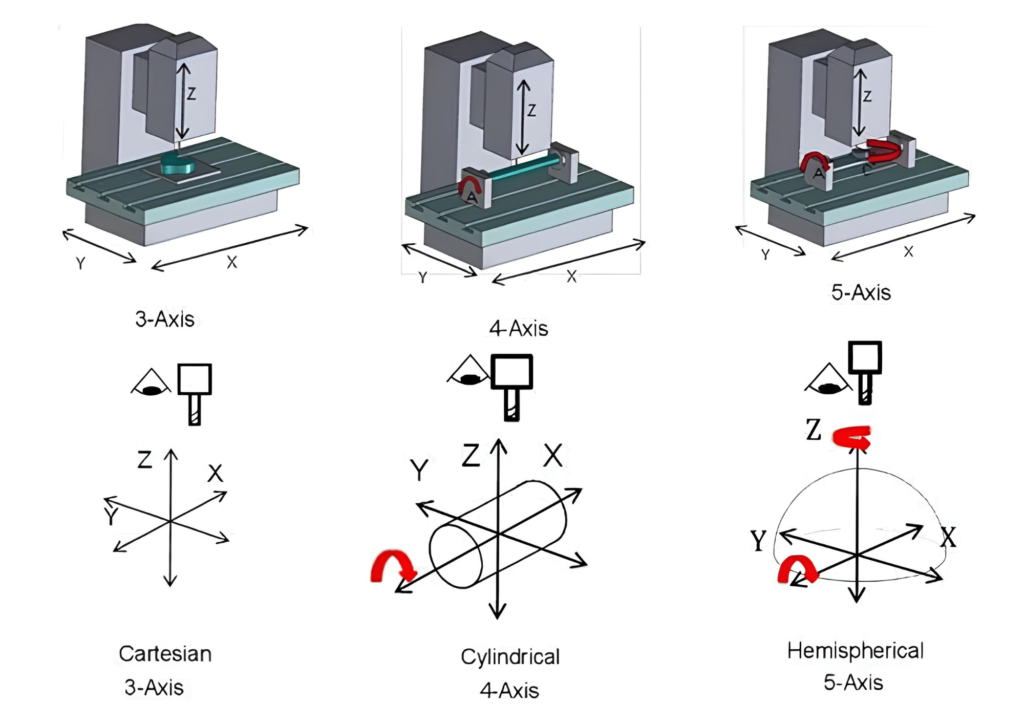
A standard 3-axis CNC machine uses three linear movements. These are the X, Y, and Z axes.
A 4-axis CNC machine adds one rotational axis. A 5-axis CNC machine adds two rotational axes.
More axes can provide better access to complex surfaces. However, more axes also increase machine complexity, programming requirements, and investment.
The right choice depends on your part design, production volume, accuracy needs, and budget.
What Is a 3-Axis CNC Machine?
A 3-axis CNC machine moves a cutting tool along the X, Y, and Z axes.
The X-axis usually controls left-to-right movement. The Y-axis controls front-to-back movement. The Z-axis controls vertical movement.
This configuration is popular because it is simple and versatile. It can handle many milling, routing, drilling, engraving, and cutting applications.
Advantages of 3-Axis CNC Machines
A 3-axis CNC machine offers several benefits:
Lower initial investment
Simple programming
Easier operation
Straightforward maintenance
Good accuracy for many applications
Wide range of compatible CNC components
A 3-axis setup can be a practical option for workshops and manufacturers producing relatively simple parts.
CNC Automation also lists a 3-axis CNC motion controller and complete 3-axis stepper motor kits for CNC applications.
Limitations of 3-Axis CNC Machines
The main limitation is tool access.
A 3-axis machine normally works on one primary orientation at a time. If a component needs machining on several sides, the operator may need to reposition the workpiece.
This creates additional setup time. It can also affect consistency if the workpiece is not aligned correctly after repositioning.
For simple components, however, a 3-axis machine can provide an excellent balance of cost and performance.
What Is a 4-Axis CNC Machine?
A 4-axis CNC machine includes X, Y, and Z movements plus a fourth rotational axis.
The additional axis is commonly called the A-axis. It rotates around the X-axis.
This rotation allows the machine to reach additional surfaces without requiring the operator to manually reposition the workpiece for every operation.
Advantages of 4-Axis CNC Machines
A 4-axis CNC machine can provide:
Better access to multiple surfaces
Fewer manual setups
Greater machining flexibility
Improved production efficiency
Better machining of cylindrical components
More efficient multi-sided operations
The fourth axis can be particularly useful when a component requires features around its sides.
4-Axis CNC Applications
Four-axis machining can suit many industrial applications.
Common examples include:
Cylindrical components
Mechanical parts
Fixtures
Industrial components
Engraving
Prototypes
Multi-sided machining
The actual performance depends on the machine structure, controller, motors, drives, tooling, and software.
What Is a 5-Axis CNC Machine?
A 5-axis CNC machine combines three linear axes with two rotational axes.
These additional rotational movements allow the cutting tool to approach the workpiece from different angles.
Some machines rotate the workpiece. Other designs tilt and rotate the cutting head.
This flexibility makes 5-axis CNC machining useful for complex parts and curved surfaces.
3-Axis vs 4-Axis vs 5-Axis CNC Machines
The biggest difference between these machines is their movement and ability to access different surfaces.
Feature
3-Axis CNC
4-Axis CNC
5-Axis CNC
Linear axes
3
3
3
Rotational axes
0
1
2
Machine complexity
Low
Medium
High
Programming
Easier
Moderate
Advanced
Multi-sided machining
Limited
Good
Excellent
Complex surfaces
Limited
Moderate
Excellent
Manual setups
More common
Reduced
Often greatly reduced
Initial investment
Lower
Medium
Higher
Best for
Standard parts
Multi-sided parts
Complex parts
The number of axes is only one factor in CNC performance. Machine rigidity, controller quality, motor selection, mechanical components, tooling, and programming also affect results.
3-Axis vs 4-Axis CNC: Which Is Better?
Neither machine is better for every application.
A 3-axis CNC machine can be the better option when most features are accessible from one direction. It also provides simpler programming and lower equipment costs.
A 4-axis CNC machine becomes more attractive when parts require machining around several sides.
For example, a manufacturer producing cylindrical or multi-sided components may benefit from the additional rotational axis.
Therefore, choose a 4-axis machine when the extra movement provides a real production advantage.
4-Axis vs 5-Axis CNC: What Is the Difference?
The primary difference is rotational flexibility.
A 4-axis machine normally provides one additional rotational axis. A 5-axis machine provides two.
This allows a 5-axis machine to approach complex surfaces from more angles.
However, 5-axis machining also requires more advanced programming and machine control.
CNC Automation provides CAD/CAM programming and CNC engineering support for applications that require optimized toolpaths and CNC integration.
CNC Controllers for Multi-Axis Machines
The CNC controller is one of the most important parts of a CNC system.
It interprets programmed instructions and controls the movement of the machine axes. A suitable controller must communicate correctly with motors, drives, sensors, and other machine components.
CNC Automation offers CNC controllers along with stepper motors, stepper drives, AC servo motors, servo drives, PLC systems, and HMI products.
For a simple 3-axis machine, the controller requirements may be relatively straightforward.
More complex machines require control systems that can coordinate additional axis movements and advanced machining operations.
How Motors and Drives Affect CNC Performance
Axis count alone does not determine CNC accuracy.
The motor and drive system also affects positioning, speed, torque, and machine response.
Stepper motors can be suitable for many CNC applications. Servo motors can provide advanced motion control for applications that require higher performance.
CNC Automation supplies stepper motors and drivers as well as AC servo motor and driver systems from brands such as Yaskawa, Mitsubishi, Panasonic, Fuji, Delta, HCFA, and Leadshine.
The motor and drive should always be selected according to machine load, speed, acceleration, axis travel, and application requirements.
Ball Screws and Linear Guides in CNC Machines
Mechanical motion components are also critical for CNC performance.
Ball screws convert rotary motor movement into controlled linear movement. They are commonly used on CNC axes that require accurate and repeatable positioning.
CNC Automation offers CNC ball screws in different sizes and leads. Its product range includes SFU 2005, SFU 2505, and SFU 3205 options.
Linear guide systems support moving machine components and help provide smooth, stable movement. Proper sizing and alignment are important for CNC accuracy and reliability.
How to Choose the Right CNC Machine
Choosing between 3-axis, 4-axis, and 5-axis machining starts with your parts.
Choose a 3-Axis CNC Machine If:
Your parts have simple or moderate geometry.
Most features are accessible from one direction.
You want simpler programming.
You need a lower initial investment.
Your production does not require frequent repositioning.
Choose a 4-Axis CNC Machine If:
Your parts require machining around multiple sides.
You want to reduce manual repositioning.
You machine cylindrical components.
You need more flexibility than a 3-axis machine provides.
Choose a 5-Axis CNC Machine If:
Your parts have complex geometry.
You need machining from several angles.
You want to reduce workholding setups.
Your production requires complex curved surfaces.
Productivity and flexibility are major priorities.
CNC Machine Cost and Total Production Cost
The purchase price should not be your only consideration.
You should also consider tooling, programming, maintenance, workholding, operator training, machine downtime, and production time.
A 5-axis machine may require a larger initial investment. However, it may reduce setups when manufacturing complex parts.
A 3-axis machine can provide better value when producing simpler components.
Therefore, compare the total cost of production, not just the machine purchase price.
CNC Retrofit and Machine Upgrades
You may not always need to replace an existing CNC machine.
A CNC retrofit can modernize an older machine by upgrading its controller, drives, motors, or other control components.
CNC Automation provides CNC retrofit and upgrade services designed to modernize machinery and improve performance without necessarily replacing the complete machine.
This can be useful for manufacturers that already have suitable mechanical equipment but need improved control or automation.
CNC Automation for CNC and Industrial Applications
CNC Automation supplies CNC components and industrial automation products for manufacturers and engineering applications in Pakistan.
Its product range includes CNC controllers, CNC machines and robots, AC servo motors and drivers, stepper motors and drivers, PLC and HMI systems, power supplies, ball screws, and linear-motion components.
The company also provides CNC machine installation and commissioning, maintenance and repair, industrial automation, CNC retrofit and upgrades, engineering support, and CAD/CAM programming.
These services can help manufacturers select, install, upgrade, and maintain CNC automation systems.
Frequently Asked Questions
Is a 5-axis CNC machine better than a 3-axis CNC machine?
A 5-axis CNC machine offers greater movement and tool access. It is often better for complex parts. A 3-axis machine can be more economical for simple components.
What is the main benefit of a 4-axis CNC machine?
The main benefit is the additional rotational axis. It allows the machine to access more sides of a workpiece with fewer manual setups.
Is 5-axis CNC machining difficult to program?
5-axis machining usually requires more advanced CAM programming. The programmer must consider tool orientation, machine movement, workholding, and collision avoidance.
Which CNC machine is best for beginners?
A 3-axis CNC machine is generally easier to understand and program. It can be a practical choice for beginners and many standard machining applications.
Does more axes mean better CNC accuracy?
No. More axes mainly provide greater machining flexibility. Accuracy also depends on machine rigidity, mechanical components, controller performance, calibration, tooling, and programming.
Final Thoughts
Understanding 3-Axis vs 4-Axis vs 5-Axis CNC Machines can help you make a better CNC investment.
A 3-axis CNC machine is suitable for many standard machining operations. A 4-axis machine adds rotational flexibility for multi-sided components. A 5-axis machine provides advanced tool access for complex parts and surfaces.
Before selecting a CNC machine, consider your part geometry, required accuracy, production volume, tooling, programming needs, workholding, and total production cost.
The best CNC machine is not necessarily the one with the most axes. It is the machine that provides the right combination of accuracy, productivity, flexibility, reliability, and cost for your application.
For CNC controllers, motors, drives, ball screws, linear-motion components, CNC upgrades, and technical support, CNC Automation provides products and engineering services for industrial CNC applications in Pakistan.