CNC Automation: Complete Beginner Guide to Automated Manufacturing
Introduction
Manufacturing has changed dramatically over the last few decades. Traditional machining methods that depended heavily on manual operation are gradually being replaced by advanced systems that offer higher accuracy, faster production, and better consistency. One of the biggest developments behind this transformation is CNC automation.
CNC automation combines computer numerical control technology with automated systems to reduce manual involvement in manufacturing processes. These systems allow machines to perform repetitive machining tasks with high precision while improving productivity, reducing errors, and maintaining consistent quality.
For beginners, CNC automation may sound complicated because it involves machines, software, electronics, robotics, and programming. However, the basic concept is simple: a computer controls the movement and operation of machines to manufacture parts automatically according to programmed instructions.
This guide explains everything you need to know about CNC automation, how it works, its components, benefits, applications, and why it has become essential for modern manufacturing.
What Is CNC Automation?
CNC automation refers to the use of computer-controlled machines and automated systems to perform manufacturing operations with minimal human intervention.
The term CNC stands for Computer Numerical Control. A CNC machine uses programmed instructions, usually created through CAD/CAM software, to control cutting tools, machine movements, and manufacturing operations. These instructions are commonly converted into machine-readable commands such as G-code and M-code.
They receive signals from the CNC controller and regulate:
Motor speed
Position
Torque
A servo system usually consists of:
Servo motor
Servo drive
Encoder feedback system
Together, they provide accurate machine movement.
4. Stepper Motors
Stepper motors are another type of motion-control motor commonly used in smaller CNC machines.
They move in precise steps instead of continuous rotation.
Stepper motors are popular because they are:
Affordable
Simple to operate
Reliable for low-load applications
They are commonly found in:
CNC routers
Desktop CNC machines
Hobby machines
5. Spindle System
The spindle is responsible for rotating cutting tools.
The performance of the spindle directly affects:
Cutting speed
Surface quality
Production efficiency
A CNC spindle system includes:
Spindle motor
Drive system
Bearings
Cooling mechanism
Types of CNC Automation Systems
CNC automation can be implemented at different levels depending on production requirements.
1. Basic CNC Automation
This includes simple automated features such as:
Automatic tool changers
Automatic coolant systems
Programmable machining cycles
This is usually the first step toward automation.
2. Fully Automated Manufacturing Cells
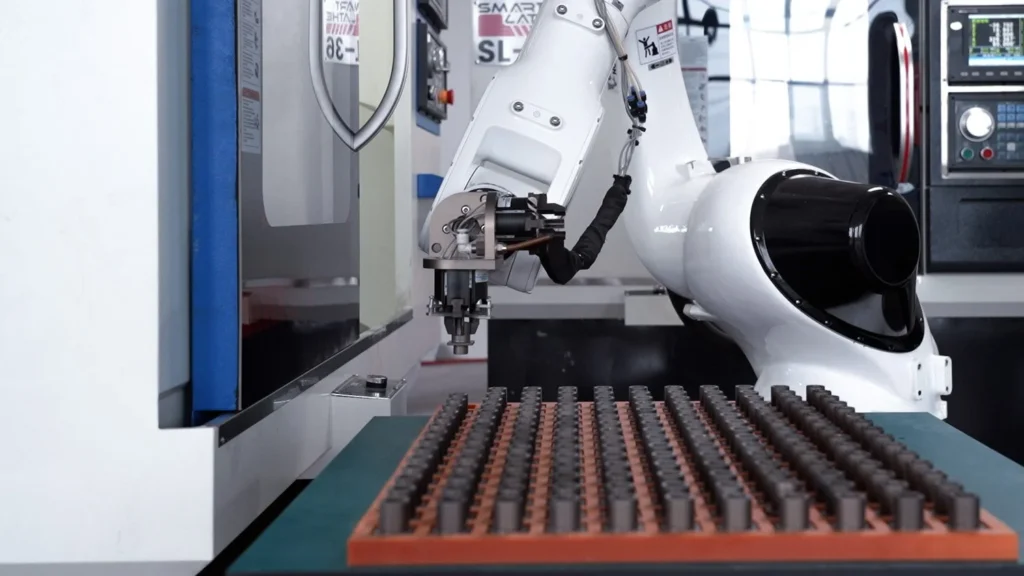
Advanced manufacturing facilities use complete automated cells that combine:
CNC machines
Robots
Inspection systems
Conveyor systems
Production software
These systems can operate continuously with limited human involvement.
Benefits of CNC Automation
CNC automation provides several advantages for manufacturers.
Increased Production Speed
Automated CNC machines can operate continuously without frequent manual intervention.
This increases production output and reduces idle time.
Improved Accuracy
Because machines follow programmed instructions, they can produce highly accurate parts repeatedly.
This is especially important for industries where precision is critical.
Examples:
Aerospace
Automotive
Medical manufacturing
Reduced Human Errors
Manual machining can introduce variations due to fatigue or incorrect operation.
Automation ensures that the same process is repeated consistently.
Lower Production Costs
Although CNC automation requires an initial investment, it can reduce long-term costs through:
Less material waste
Reduced downtime
Higher productivity
Lower labor requirements
Industries Using CNC Automation
CNC automation is used across many industries.
Automotive Industry
Automotive manufacturers use CNC automation to produce:
Engine components
Transmission parts
Vehicle components
High production volume and accuracy make automation essential.
Electronics Industry
CNC automation is used for:
Precision components
Electronic housings
Small mechanical parts
Challenges of CNC Automation
Although CNC automation provides many benefits, businesses should consider some challenges.
High Initial Investment
Automation equipment, robots, software, and integration require significant investment.
Technical Knowledge Required
Operators need skills in:
CNC programming
Machine operation
Maintenance
Troubleshooting
Maintenance Requirements
Automated systems require regular maintenance to maintain accuracy and reliability.
Integration Complexity
Connecting CNC machines with robots, sensors, and production systems requires careful planning.
Future of CNC Automation
The future of CNC automation is moving toward smarter and more connected manufacturing.
Future developments include:
Artificial Intelligence
AI will help machines:
Predict failures
Optimize cutting parameters
Improve production efficiency
Smart Manufacturing
Factories are becoming more connected through:
IoT sensors
Cloud monitoring
Data analytics
Robotics Integration
More manufacturers are adopting robotic systems for:
Material handling
Inspection
Automated production
Lights-Out Manufacturing
Advanced CNC systems can operate for extended periods with minimal human supervision, sometimes during unattended shifts.
Conclusion
CNC automation has become one of the most important technologies in modern manufacturing. By combining computer control, precision mechanics, software, and automation systems, CNC machines allow manufacturers to produce high-quality components faster and more efficiently.
Whether you are a student, engineer, manufacturer, or business owner, learning CNC automation provides valuable knowledge for understanding the next generation of manufacturing.
4 Responses