Every CNC machine relies on a system of axes to move tools and materials with precision. Understanding these axes helps you grasp how CNC machines create complex parts, from simple drilled holes to intricate 3D shapes. This guide breaks down CNC machine axes in detail, explaining how each one works and why the number of axes matters for manufacturing.
What Are CNC Machine Axes?
CNC machine axes define the directions in which a machine’s tool or worktable can move. Each axis represents a specific path of motion, and together they allow the machine to position the cutting tool exactly where it needs to be.
Why Axes Are Fundamental to CNC Machining
Without a clear axis system, CNC machines couldn’t execute precise, repeatable movements. Every programmed instruction relies on this coordinate system to guide the tool accurately.
The Basic Linear Axes: X, Y, and Z
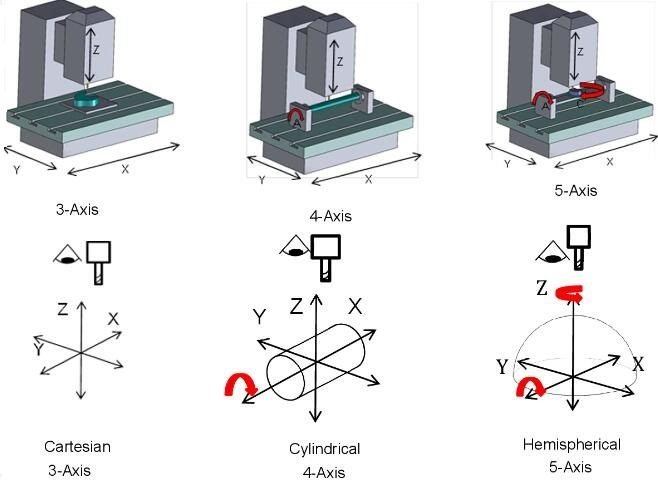
Most CNC machines start with three fundamental linear axes. These form the foundation of nearly all machining operations.
X-Axis: Horizontal Movement
The X-axis controls side-to-side movement, typically from left to right. On most machines, this represents the primary horizontal direction of travel.
Y-Axis: Depth Movement
The Y-axis manages front-to-back movement, adding depth to the machine’s positioning capabilities. Together with the X-axis, it defines a flat, two-dimensional plane.
Z-Axis: Vertical Movement
The Z-axis controls up-and-down movement, usually representing the tool’s depth of cut. This axis is critical for controlling how deeply the cutting tool engages with the material.
How X, Y, and Z Axes Work Together
When combined, the X, Y, and Z axes create a three-dimensional coordinate system. This allows the CNC machine to position the cutting tool anywhere within its working space.
Example of 3-Axis Movement
For instance, milling a rectangular pocket requires coordinated movement along all three axes — moving horizontally and vertically while adjusting cutting depth simultaneously.
Limitations of 3-Axis Machines
While versatile, 3-axis machines can only approach the workpiece from one direction at a time. As a result, complex geometries often require multiple setups, increasing production time.
Rotational Axes: A, B, and C
Beyond basic linear movement, many advanced CNC machines include rotational axes, allowing the tool or workpiece to rotate around a fixed point.
A-Axis: Rotation Around the X-Axis
The A-axis enables rotational movement around the X-axis, allowing the workpiece or tool to tilt for angled cuts.
B-Axis: Rotation Around the Y-Axis
Similarly, the B-axis provides rotational movement around the Y-axis, expanding the machine’s ability to reach complex angles.
C-Axis: Rotation Around the Z-Axis
The C-axis rotates around the Z-axis, often used in combination with other axes for intricate, multi-directional cutting.
Understanding 4-Axis and 5-Axis CNC Machines
What Makes a 4-Axis Machine Different
A 4-axis CNC machine adds one rotational axis, typically the A-axis, to the standard X, Y, and Z linear axes. This allows the workpiece to rotate during machining, enabling more complex cuts without repositioning.
The Power of 5-Axis Machining
5-axis machines combine all three linear axes with two rotational axes, allowing the cutting tool to approach the workpiece from nearly any angle. Consequently, this dramatically reduces the number of setups needed for complex parts.
Benefits of Additional Axes
Fewer manual repositioning steps
Improved surface finish on complex geometries
Reduced production time for intricate parts
Greater design flexibility for engineers
Real-World Applications by Axis Count
3-Axis Machines in Everyday Manufacturing
3-axis machines remain popular for simpler parts, such as flat panels, basic brackets, and standard drilled components, due to their lower cost and easier programming.
4-Axis Machines for Cylindrical Parts
4-axis machines are often used for parts requiring rotational features, such as camshafts or cylindrical components with side-drilled holes.
5-Axis Machines for Aerospace and Medical Industries
Industries like aerospace and medical device manufacturing frequently rely on 5-axis machines to produce complex, curved parts with tight tolerances in a single setup.
How Additional Axes Improve Precision
Fewer Setups Mean Fewer Errors
Every time a part is repositioned on a machine, there’s a risk of misalignment. Multi-axis machines minimize repositioning, therefore reducing the chance of cumulative errors.
Better Surface Finishes
With more axes, the cutting tool can maintain optimal contact angles throughout the machining process, resulting in smoother, more consistent surface finishes.
Complex Geometries Made Possible
Certain shapes, like turbine blades or medical implants, simply aren’t achievable with basic 3-axis machining. Additional rotational axes make these intricate designs possible.
Choosing the Right Axis Configuration for Your Needs
Consider Part Complexity
Simple, flat parts typically don’t require more than three axes, while intricate geometries benefit significantly from 4 or 5-axis capabilities.
Factor in Production Volume
For high-volume production of complex parts, investing in multi-axis machines can reduce cycle times and improve overall efficiency.
Evaluate Budget and Training Requirements
Multi-axis machines come with higher upfront costs and require more advanced programming knowledge. Therefore, it’s important to weigh these factors against your production needs.
Common Misconceptions About CNC Axes
More Axes Always Mean Better Results
While additional axes offer more flexibility, they aren’t always necessary. Simple parts can often be produced just as effectively, and more affordably, on 3-axis machines.
All 5-Axis Machines Work the Same Way
Not all 5-axis machines are identical. Some use a trunnion table design, while others rely on a swiveling head, each offering different advantages depending on the application.
Final Thoughts
CNC machine axes form the foundation of precision manufacturing, determining how a machine moves and shapes material. From basic X, Y, and Z linear movement to advanced 5-axis configurations, understanding these systems helps manufacturers choose the right equipment for their specific needs. As parts become more complex, multi-axis machining continues to play an increasingly important role in producing accurate, high-quality components across industries.