Choosing the right CNC control system can affect accuracy, reliability, productivity, and machine cost. Understanding Open Loop vs Closed Loop CNC Systems helps manufacturers select the right motion-control solution for their CNC machine.
What Is a CNC Control System?
A CNC control system manages machine movement based on programmed instructions. It controls components such as motors, drives, spindles, and machine axes.
The control system determines how accurately and consistently a CNC machine follows its programmed path. Two common approaches are open loop and closed loop control.
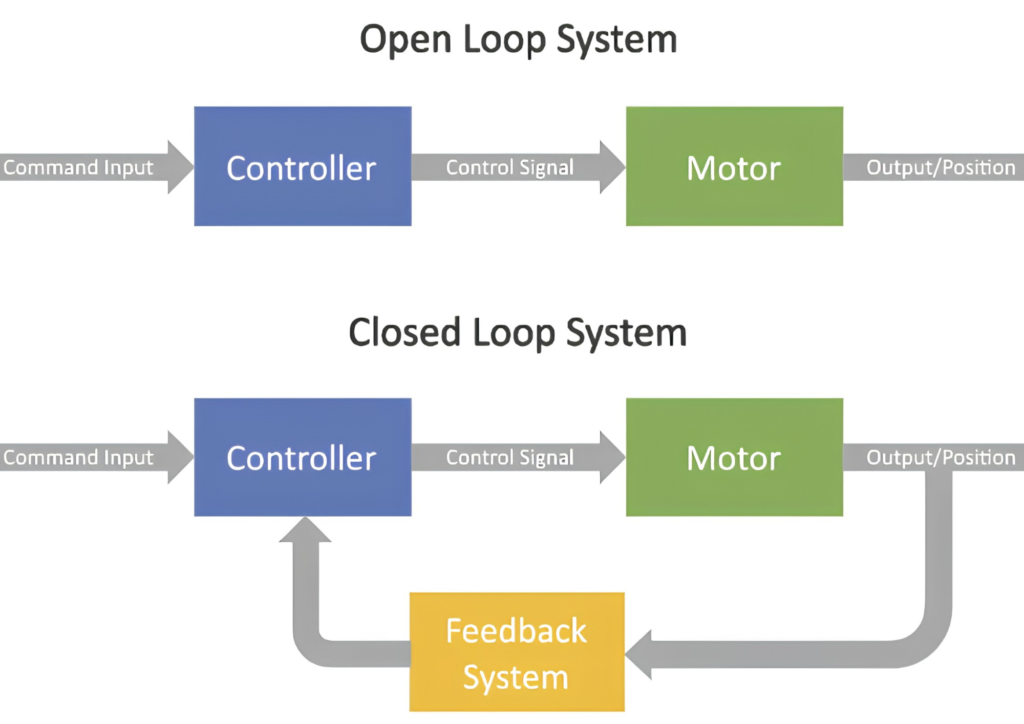
The main difference is feedback. An open loop system operates without checking the actual position of the motor. A closed loop CNC system uses feedback to compare the commanded position with the actual position.
What Is an Open Loop CNC System?
An open loop CNC system sends commands to a motor without receiving position feedback.
Stepper motor systems are common examples of open loop CNC control. The controller sends electrical pulses to the stepper drive. The drive then moves the motor according to those commands.
The system assumes that the motor follows every command correctly. It does not continuously verify the motor’s actual position.
How Open Loop CNC Systems Work
An open loop CNC system usually includes:
CNC controller
Stepper driver
Stepper motor
Power supply
Mechanical transmission
CNC machine axis
The controller calculates the required movement. It sends pulses to the driver, which controls the stepper motor.
For example, if the controller sends pulses representing a specific distance, the motor should rotate enough to move the axis that distance.
This design is simple and cost-effective. However, it cannot automatically detect whether the motor has lost position.
Advantages of Open Loop CNC Systems
Open loop CNC systems offer several benefits:
Lower system cost
Simple installation
Easier troubleshooting
Straightforward wiring
Simple control architecture
Suitable for many CNC applications
They are often suitable for CNC routers, engraving machines, small milling machines, and other applications where loads remain predictable.
Limitations of Open Loop CNC Systems
The main limitation is the lack of feedback.
If the motor misses steps because of excessive load, acceleration, or mechanical resistance, the controller may not know that the actual position is different from the commanded position.
This can result in machining errors.
Therefore, open loop control is most suitable when the machine has predictable loads and the required accuracy can be achieved without continuous position feedback.
What Is a Closed Loop CNC System?
A closed loop CNC system uses feedback to monitor actual machine movement.
The system compares the commanded position with the actual position. If there is a difference, the controller or drive can respond to correct the error.
Closed loop systems commonly use servo motors with encoders or other feedback devices.
How Closed Loop CNC Systems Work
A typical closed loop CNC system includes:
CNC controller
Servo drive
Servo motor
Encoder or feedback device
Mechanical transmission
CNC machine axis
The controller sends a movement command to the drive. The servo motor moves the axis, while the encoder reports the actual position.
The drive compares the commanded and actual positions. It then adjusts motor operation when necessary.
This feedback process helps the machine maintain accurate movement during demanding machining operations.
Open Loop vs Closed Loop CNC Systems
The key difference between open and closed loop CNC systems is feedback.
Feature
Open Loop CNC
Closed Loop CNC
Feedback
No
Yes
Common motor
Stepper
Servo
System cost
Lower
Higher
Control complexity
Lower
Higher
Position monitoring
No direct feedback
Continuous feedback
Error correction
Limited
Available
Maintenance
Generally simple
More components
Best for
Predictable loads
Demanding applications
Neither system is automatically better for every CNC machine. The correct choice depends on machine size, load, accuracy, speed, budget, and application requirements.
Stepper Motors in Open Loop CNC Systems
Stepper motors are widely used in open loop CNC applications.
A stepper motor moves in controlled increments. The CNC controller sends pulses to the stepper driver, and the driver energizes the motor windings in the required sequence.
This provides precise and repeatable movement when the motor remains within its operating limits.
Stepper systems are attractive because they offer relatively simple control and can provide useful torque at lower speeds.
However, the system needs proper motor sizing. Excessive loads or aggressive acceleration can cause missed steps.
CNC Automation offers stepper motors and drivers for CNC and industrial motion-control applications. These components can be selected based on machine requirements and axis loads.
Servo Motors in Closed Loop CNC Systems
Servo motors are commonly used in closed loop CNC systems.
A servo system uses feedback to monitor motor position and movement. The encoder provides information to the drive, allowing it to control the motor accurately.
Servo systems are useful when machines require high speed, precise positioning, fast acceleration, and reliable motion control.
They can also respond to changing loads more effectively than many basic open loop systems.
CNC Automation providesAC servo motors and driversfrom several industrial manufacturers for CNC and automation applications.
Benefits of Servo CNC Systems
Closed loop servo systems can provide:
High positioning accuracy
Fast response
High operating speeds
Continuous position feedback
Better control under changing loads
Improved motion performance
However, servo systems usually require a higher initial investment and more advanced setup.
When Should You Use an Open Loop CNC System?
An open loop system can be a good choice when cost and simplicity are important.
Consider open loop control when:
The machine has predictable loads.
Axis speeds are moderate.
Extremely high positioning performance is not required.
The machine is relatively small.
You want a simple control system.
Your budget is limited.
For many hobby, educational, woodworking, engraving, and light-duty CNC applications, a properly sized stepper system can provide reliable performance.
When Should You Use a Closed Loop CNC System?
Closed loop CNC control is more suitable for demanding applications.
Consider a closed loop system when:
High positioning accuracy is important.
The machine operates at higher speeds.
Axis loads can change significantly.
Production reliability is critical.
You need feedback and error monitoring.
The machine performs demanding industrial operations.
Industrial milling machines, production equipment, and high-performance CNC systems can benefit from closed loop servo control.
CNC Controller Selection Matters
The motor is only one part of the CNC motion system. The controller, drive, feedback device, mechanical transmission, and power supply must work together.
A suitable CNC controller should support the required number of axes and provide the control features needed by the application.
CNC Automation supplies CNC controllers, stepper motors and drivers, AC servo motors and drivers, PLC and HMI systems, and other industrial automation products.
Proper component matching is essential for achieving stable CNC performance.
Mechanical Components Also Affect CNC Accuracy
Even an advanced closed loop system cannot compensate for every mechanical problem.
Backlash, poor alignment, excessive vibration, worn components, and inadequate machine rigidity can affect machining results.
Ball screws, linear guides, couplings, bearings, and other mechanical components must be selected and installed correctly.
CNC Automation supplies CNC ball screws and linear motion components for CNC machine and automation applications.
A well-designed CNC system combines good electronics with strong mechanical construction.
Open Loop vs Closed Loop: Which Is Better?
There is no universal answer.
An open loop CNC system can deliver excellent value for applications with predictable loads and moderate performance requirements. It is simple, affordable, and easier to maintain.
A closed loop CNC system provides feedback and improved motion control for demanding applications. It is usually the better option when accuracy, speed, and production reliability are priorities.
Before choosing, evaluate the machine’s load, speed, accuracy, production volume, and budget.
Final Thoughts
Understanding Open Loop vs Closed Loop CNC Systems is important when designing or upgrading a CNC machine.
Open loop systems usually use stepper motors without position feedback. They offer simplicity and lower cost.
Closed loop systems commonly use servo motors and encoders to monitor actual movement. They provide greater control and are better suited to demanding industrial applications.
The best CNC control system depends on your specific requirements. By selecting the right controller, motors, drives, feedback devices, and mechanical components, you can build a CNC system that delivers reliable and accurate performance.